Showing posts with label trust. Show all posts

Tuesday, June 28, 2016

"Next Year We Should Have Trillions"

It happened again. I watched a TedTalk (by John Hunter) and got inspired.  


  • His fourth graders solved 50 world crises?! 
  • That game board is so cool!
  • We'd learn so much by trying that!
  • It looks impossible to implement and figure out!
  • Can't wait to read his book!
I work at an alternative school.  We teach the .01% of our district's students who have not been able to be successful in their home school.  Whenever I thought about the World Peace Game, it seemed like our students might not have what it takes to play the game.

Hunter states in his book:
"Students must: possess a certain “intellectual stamina” and be able to wrestle with tough problems that are without quick or easy resolution, over time; be able to interact constructively with others much different from themselves (diversity as much as possible); be able to forestall closure and handle the certain frustrations of endless challenges and conflicts as they collaborate to achieve peace."


Well...our students are placed at our school for the very reason that they have NOT shown the ability to do the very things Hunter lists as required traits. 

So I waited a couple of years until I couldn't stand it any longer...and the time seemed right. My co-teacher is amazing and always willing to jump off metaphorical cliffs with me. So. We jumped.

Reading John's book was helpful, but he is very non-prescriptive. We had to figure out almost everything on our own. Hunter travels around the world and teaches the World Peace Game internationally, but that was not an option for us. Luckily, his book and TedTalk gave enough inspiration and information for us to give it a shot.

We had to adapt many aspects of the game. John Hunter, as far as I can tell, does the game with one full class of 20+ fourth graders all together in one room. We have four separate small classes of middle schoolers. So each of our first three classes became a country, and our fourth class became the United Nations/World Bank.

Hunter's game board is four levels high and takes 3 hours to set up! Ours needed to be sturdy, safe and easily moved. We created a flat game board using corrugated plastic cardboard from Lowes, and used putty and a hot glue gun to attach objects as we played. The students loved the game board! We had a crisis list of 20 crises, reduced from Hunter's 50.

As Hunter does in his games, we chose the Prime Ministers, and the Prime Ministers then chose and nominated their cabinet members for their class. Students could accept or refuse their nominations. All but one accepted. Each student had a job in the cabinet. These were posted on our interactive bulletin board.


Since collaboration skills are integral to success in complex problem solving, we used a business meeting format with the BIE Collaboration Rubric to structure the game for each class.


The Prime Ministers gradually learned to run the business meetings using the printed meeting Agendas, with lots of support from staff. We played the game almost daily for a six-week time period, and then spent a week reflecting.


By the end, all 20 world crises had been solved, the game board was intact and more complex due to additions of a college and electricity (among other things), and there was no tangible reward asked for or given. Leaders emerged, artists created, math whizzes excelled, collaboration improved, and fun was had.

We won.
That was the reward.


In the video, you will see more details about the Game, the classroom, and what the students thought about the experience.

I will end with this -
It was fun.
We all learned a lot.
I can't wait to do it again next year.
Enough said.


Sunday, November 8, 2015

Engaging the Recalcitrant, the Trepidatious and the Surly

Term 1 was hideous.

Still, I was excited to start a Choose Your Own Adventure unit with my students. [I guess that's much of what being a teacher is - still getting excited after a million failures.] I knew it would fail with many of our kids, but my hope was that it would grab one or two students who might have otherwise just cussed me out [again].

So far, the story creation is working [shockingly] well.

Our goal for the project is a Choose Your Own Adventure on Google Slides like this:
The Journey of Tannock

Before things go south, I wanted to share some of the characters they have created. I have not edited their writing.  This was step one.  Wish us good luck with the rest of the steps!

  
His name is Fire Hawk. He is 20 ft tall and he is shaped like muscular and strong. His skin is green. He has a problem and it is anger issues. He has had three important events in his life .The first was  people dying in his family.  This made him really frustrated and down.  This made him decide to destroy things because that made him happy. The second was getting into fights and that caused him to get mad.  The last important event was he started to become more happy.  This made him decide to try to save the world. 

Titanium (no description yet)

DT is 17 years old tennager in the city of ember  all his family died from an evil race of 380s gang he has set out to find them help dt revenge his family.

this is nick he fell in a pool of toxic waste and that's what happened to him he got powers as well he was a 10 year old boy he has lived 100 years since then he cannot die he dosnt remember how it happend to him now hes on his way to find out what had happened  and why

(no description yet)

(no descriptions yet)

His name is Lobo {wolf} and he is black,brown and blue wolf.With yellow eyes that reflect the moon.He carries a spear with him with a egel on the top.He is 56 years old and he is part wolf part human and he is the only wolf like that.His pack of 5 wolfs and they all listen to him and he can speak to them he runs the whole woods.He can live till he's 169 years old and he has to protect his pack he only .He is very strong and he can see from 576 miles away and can hear from 36 miles away and can left up to 1,562 pounds. The pack is from Mexico and they now live in South Dakota.

I will end with this:


Sunday, July 12, 2015

Where was your shoe? Low Tech Game-ishness In Middle School


We have had an amazing week with our game design and reflection unit!

Kevin Hodgson has asked us to reflect on implications for our classrooms.

I have a few simple offerings that we have used with some success in our alternative middle school.  In our setting, we often have to go to great lengths to "engage"! And none of these ideas uses much technology.

1.  I highly recommend the book to the left.  It was suggested to us by a professional storyteller, Geraldine Buckley, who came to our school a couple of years ago to teach storytelling.  [She is amazing, by the way.  You should have her come to your school!]

This book gives a wide variety of interactive storytelling games, with many different entry level skills, and has a naturally high ceiling.  One of the games we start with is, "Where was your shoe?" We sit in a Circle, and everyone sticks his or her shoe into the center. We then take turns telling a story about a place our shoe has been.  This could be true or fanciful.  The point is to build comfort levels.

2.  Standardized testing - my co-teacher and I make a game of district-based timed assessments.  Each time we finish a section, students get a raffle ticket to put in a jar.  At the end , we pick names for a small prize.  This keeps things moving, gives some incentive to get through the sections, and makes a horrible experience more fun for all! 

3.  BIE Collaboration rubric - we use this team-wide and I HIGHLY recommend it. Particularly now that CCSS includes standards such as, "Engage effectively in a range of collaborative discussions," this rubric has been a godsend in terms of breaking down the skills of collaboration and helping students self-reflect.  And actually it is appropriate for all ages, including adults with some adaptation.


4.  Gamifiying for staff planning days - When my entire middle school staff was given a planning day together, our assistant principal visited every classroom, all of whom had substitute teachers because we were planning elsewhere, and told them that the day was now a game, and the class which earned the most points that day would earn a pizza party. This simple act made the day better for all involved and gamified what could have been a very stress-filled situation. 


Preparing creative meal!
5.  When we divided the middle school up into collaborative groups to do two Chopped-style team-building days with students, planning the day as a structured game led to higher levels of student engagement.  We did this one day with cooking, and another day with constructing a bird feeder.  Staff then voted on the best meal or the most well-designed bird feeder. Having the day laid out as a game ahead of time allowed students to have background knowledge of how the day would proceed, layered on top of the advance notice we always give for schedule changes and special activities.


Presenting meal to the judges.


None of this is revolutionary, but I wanted to share a few simple game-ish things that we have found success with. While it might sound as if a lot of extrinsic reward was involved, that element actually ended up playing very little part in the successes. The game aspects simply lowered stress levels, increased fun levels, and gave an implicit structure to a set time period. All of these things typically lead to more success for our students. The game aspect also led to a natural rallying together of students who normally do not like working together and who are generally unsuccessful in teamwork. In order to "win," they put aside some of the petty differences.

Our CLMOOC unit has given me many more tools and concepts for my Game Toolbox. As I reflect more on this experience, I plan to incorporate the Makes I have seen [and done] in order to more systematically plan for and gamify my classroom. Lots more thinking to do, but thank you for all of the great ideas you have shared, including your processes and "failures" iterations!

Thursday, July 9, 2015

When It Rained In My Living Room

One time I remodeled my entire bathroom by myself.

I had no idea what I was doing, but ignorance was bliss.  For a while.

Two days into it, the bathtub and shower were installed and ready to go.  I filled the tub.

"Mom!  Is it supposed to be raining in the living room?!" my daughter called out.

[It was a non-rhetorical rhetorical question.]

Had I checked for leaks before filling the tub?  

No.

Had I any idea of what was getting myself into?

No.

Enter Make Cycle 3 and our Official Game of the Museum of Obscure Joys and Sorrows (O.G.M.O.J.S.).

It started out as a curiosity - the freshly created words of John Koenig were posted on Facebook, prompting Terry Elliott and I to think "That's really cool!" and ask CLmooc-ers to create words.

The words we created are here: Spreadsheet of everyone's ideas.

Terry's Hackpad Intro

No one wanted the words to languish in a spreadsheet. So when Make Cycle 3 came out, I innocently thought, "I will use the words to make a game!"

I played around with some gamification ideas - badges, an e-portfolio. I went against the competitive spirit by making all of the badges available to everyone, even if they didn't "earn" them. It was fun, which was the most important thing to me when I started.


But...
Like my bathroom remodel, I had no idea what I was getting myself into. Also like my bathroom remodel, I learned a ton throughout the painstaking process. And...like my bathroom remodel, it took WAY longer than I thought it would. 

Why?
  • I had to figure out a few technical things. I tend to be pretty perfectionistic in these things, and would not settle for a mediocre attempt.
  • I felt a huge responsibility to the folks who had contributed words.  I wanted to do them justice and honor them.
  • Terry gave me some great feedback along the way, leading (amongst other revisions) to the escape hatch feature.  I wanted to add his soundtrack but just ran out of steam before I could figure it out.
  • I didn't want to half-ass it.


I like the wormhole-ish nature of some of it.
I love the words people made.
I love the gifs and the badges.
I like the escape hatches.

I didn't like the tediousness of making sure all of the clicks and links do the correct things. And I am sure I missed some (let me know).
I had hoped to make it sillier and more fun, but (again) I am just too tuckered out to work on it any more.
I had hoped to use feedback from more game testers. And maybe I will get that chance.


The bottom line is that I really wanted to see what potential was there for my classroom, and in that regard I am really excited to try the template out next fall. The possibilities are tremendous.

In terms of strict game design, it wouldn't score very well.  It's not really replayable, it's not that interactive, and you can't really control much of the outcome.

But I am happy with it and excited that we got to use the Obscure Joys & Sorrows that CLmooc-ers came up with!

A great collaborative effort.

Special thanks to: 
Christina DiMicelli
Sheri Edwards
Sarah Honeychurch
Terry Elliott
Scott Glass
Susan Watson
Stephanie West-Puckett

Amy Cody Clancy

The game is here: GAME


Wednesday, July 1, 2015

No bourgeois bacon

This blog post sucks.

It is made to disappoint.

Interpret it as you will.

Willfully misinterpret it.

Tear it up, print it out and burn it.

Tell me what to do.

I am a medium.

I am medium.

Medium height, medium smart, medium rare, medium class.

Think about this, then blog about it:

Do as you are told.  No comic sans. No bourgeois bacon.  No hipster rouge.  No techie Captain Crunch.

Ready set go.

Wednesday, June 24, 2015

Don't Sit on My Fire Hydrant


image 4219


Anna Cow brought up a theme that has been running through my mind since I read our Make Cycle 1 assignment email, which asks, "Could shattering the parameters of our introductions help us to move more quickly beyond 'you' and 'us' to a space where equity and diversity are hallmarks of a shared 'we'?"

What does it mean to welcome someone, and what power dynamics are at play?  Anna distinguishes between the French concept of hospitality, which is "mainly let someone stay without asking money (sleep and live) under one's roof" and the English concept, "receptive and open-minded, welcoming, and it also about parties and meals."

"Hospitality is not in the place it is in the human."

In January, I went to a TedTalk in Baltimore, Maryland, U.S. The theme was "Collisions." Much of the content in the amazing talks had to do with Equity of Access.  Ruha Benjamin's TedTalk has stuck with me (as has Jimmy Lin's but for corollary reasons). 

Ruha reminded us that "At the heart of discriminatory design is this idea that we can design technological fixes for social crises."

Ruha asks, "Whose voices are missing at the lab bench?"


Metal studs outside private flats on Southwark Bridge Road, London.
Metal studs outside private apts. in London
Concrete spikes under a road bridge in Guangzhou city, Guangdong, China.
thisbigcity:

retorsion:
Photos by Arnaud Elfort, Guillaume Schaller (source: Flickr)
Disciplinary Architecture / Discriminatory Architecture [PART 2]
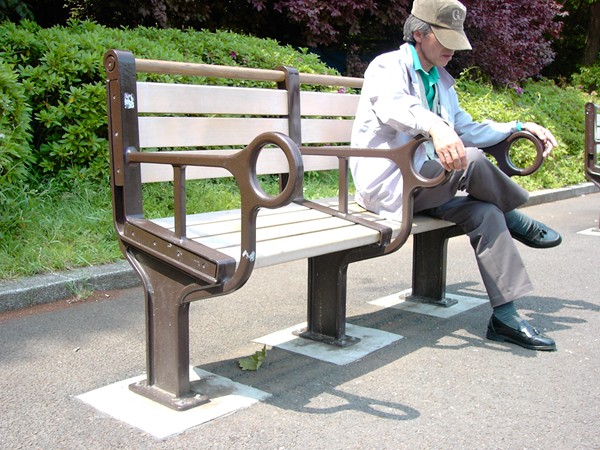
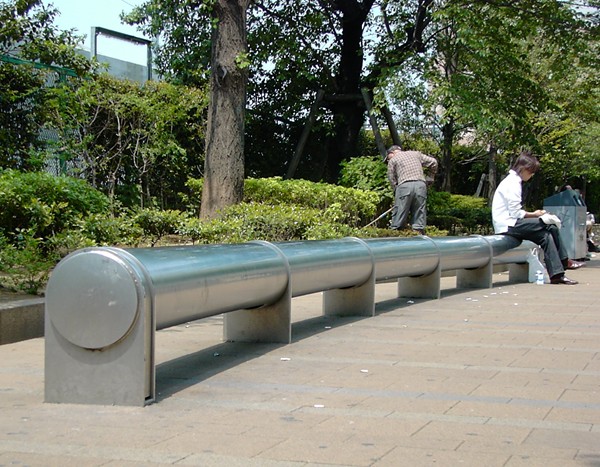
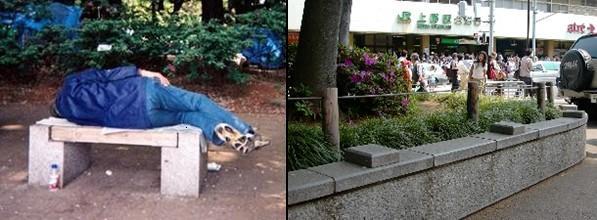
Anti-homeless architecture is growing and pushing back the poorest towards zones even more inhospitable. This ordered violence, indifferent to the sufferings of others, takes part in the degradation of human relations and is a quiet and paradoxical response to ultimate precariousness.

Anti-sitting, anti-homeless design. How inviting. 

This sort of thing isn’t only anti-homeless, it’s anti-life.
Everyone who sees this incurs mental harm. Each jagged edge is a whip that bullies us into forgetting that a city must retain a communal sense of ownership.
How is this success? Who wins when simply looking at the place you call home makes you flinch?
What is Discriminatory Design? It is design intended to manage people. Usually, it is intended to manage people who fall into categories that the powers-that-be find to be a nuisance, or worse. It could be spikes to prevent the homeless from sitting, sleeping, or lying down. 
It could be creating separate entrances to the same building, one for poor residents and one for the wealthy. It could be benches designed [ostensibly] for one person, or benches so uncomfortable that one can only sit for a few minutes before needing to get up. 
Some cities have gotten creative in their discriminatory design, making the designs into "Art Pieces."   As the article states, "One cannot sit on these colorful "artistic" objects, strategically placed to give the impression that one can rest, but having the opposite function."  The author asks, "Are public places for everyone?"


Clearly, no one in #CLMOOC is purposely using discriminatory design.

But I think it is important in any arena which is inherently entitled, such as an online class, to keep in mind those design elements which might be unintentionally preventing people from feeling included, safe, welcome or welcomed.  Like the frog in the pot of water on the stove who doesn't realize that the temperature is rising until it is too late, we can become so immersed in our own experience that we forget what it feels like from different perspectives.  

Are there spikes on any of our benches that we were not aware of?  

"Hospitality is not in the place it is in the human."

Yesterday I sent out a survey to briefly gauge how comfortable people are feeling with #CLMOOC.  Since there are over 2000 people in the Community, and so far 34 have responded to the survey, I can't say that it is a scientific representation, but I have found that anonymous surveys tend to attract a decent cross-section of those who are fairly content and those who have concerns that they haven't been able to express in another arena.  

What is one word you would use to describe #CLMOOC right now? 
White
Exciting!
Bubbling
Peculiar
Limited
Fun
confusing
energy
Energizing
intriguing
Catalyst
catalyst
play
busy
Creating
collaborative
Inspiring
positive
opportunity
energetic!
inspiring
opening
intriguing
Fun
frantic
Create
overwhelming
exploring
rejuvinating
Disorganised
tentative
What is one question you have for or about #CLMOOC?

Are all the prompts connected to connected learning principles?
????
Connected to each other by...what?
What's going on? What am I making?
When are you going to stop dictating and start involving all of us in designing this?
I am pretty sure I officially signed up, but I haven't received a newsletter email yet. Where should I check to make sure that I am actually registered?
I do not see a purpose for the "untro" and feel it is a wasted week. It is too deep, too complex. If you want new invitees to feel comfortable in this space, it had better start in an easy to understand manner. What is the purpose of the week 1 make? How would I bring this into my classroom and use with students, or into a staff meeting to use with staff? I just don't see it and I am a creative person. Honestly, this 1st week is a huge potential turn-off to newbies. I'm hoping next week is more practical.
How do we build community [based on tweet https://twitter.com/NomadWarMachine/status/613491511989174272 ]
How important is it that your experience in the mooc transfer to your classroom? Is the mooc about nuts and bolts or inspiration?
I don't know enough yet to have questions.
Any representation of clmoocers at ISTE2015?
How long does an individual cycle last? Is it only a week?
How do we find more equity? (e.g. How do we make this less for "insiders"?)
How will I apply this experience in my teaching?
None
Where are we going?
Do you really want 2000 people posting their make projects? I posted my intro first night, but now it is overwhelming with un-intros.
How long will the links last?
How can CLMOOC concepts be made more appealing (obviously relevant and beneficial) to a wider audience, and a broader number of disciplines?
Is there enough collaboration going on? or just silos?
How do I become more involved and what are examples of transferring CLMOOC experiences in the classroom?
How will we get every one to feel ownership of clmooc.
Any plans to make this a year-round thing?
Where are we heading?
Where have all these wonderful people been?
How can we get even more people involved?
Did anybody think about how this was going to work? It does not seem as if any of the 'organisers' have any expertise. For example, the first 'webinar' was a shambles of people chatting, not a webinar at all, and the first make is ridiculous. I thought this was a community mooc, it's not. The organisers are just up themselves.
Must it be visual?
[Thank you to everyone who has responded or will respond to the survey!]

I will let you do your own analyses of the responses so far.

In the meantime, I challenge us to create solutions to any barriers that might exist in our design, if any.

Creative Solutions
The following people have responded to design issues very creatively: 

Rain City Housing created benches that became shelters: raincity

Michael Rakowitz designed paraSITE shelters as practical solutions and a protest against policies that he felt were harmful to homeless people:

Sara Ross  designed outfits that would allow the wearer to circumvent the spikes or discomfort:
Archisuit in use on bench

Finally, this video shows how a community in Oxford worked to create a sense of place where people would WANT to be, rather than using speed bumps and negative architecture to try to control people. "A painted "street carpet" was used to slow down speeding traffic and create a greater sense of place...Rather than forcing drivers through physical features like speed humps, and making pedestrians feel they can't use the space, it makes them aware of their surroundings and the street as a place for people."

I am playing devil's advocate here. Are there ways that we can create more of a sense of place in #CLMOOC?  
Are there ways we can more creatively make this experience more equitable?  More welcoming to new players? 
Can communication be improved somehow?  Does it need to be improved? Does it need to be more equitable? 
Are there inherent design issues that we can improve? 

No experience can be or will be positive and productive for every player.  But since we are asked to create "a space where equity and diversity are hallmarks of a shared 'we'," I think we need to at least ask the questions.

What do you think?


Peace in the questioning,
Susan @eatcherveggies