Showing posts with label middle class. Show all posts

Monday, July 20, 2015

#AccidentalPumpkin's Rules for Public Spaces

I checked my Homeowner's Association regulation handbook. Nowhere does it have a rule against having a gigantic accidental pumpkin growing in your front yard.


It's not a "public space," but it is governed by public rules.

I have gotten reprimand letters in the past for having a 2X4 leaning on my back fence and for having a broken fence after a storm.  (And when I was really sick, for having grass that made the house look like a crack house needed cutting.)

My neighborhood is unabashedly lower-middle class/middle class.  I chose it for four reasons:

---It was in my daughter's school district
---It was affordable
---It is racially diverse
---I am unabashedly lower-middle class/middle class. These are my peeps. I am their peep. 

I love it here.

The pumpkins I actually planted on my back deck have already died due to fungus.  

The #accidentalpumpkin lives on.

I think she is the weebaby progeny of my Halloween pumpkin last year.  

The townhouse right next door is abandoned.  The front yard has been overtaken by a mass of uber-prickly weeds that are far taller than me.

I could cut them down, although the barbs go right through my gloves.

But I choose not to, because the animals like the cover the weeds provide.  The birds and rabbits and squirrels, and who knows what else - they don't think they are weeds; they think they are a playground.  

I am sure the owner has received numerous reprimand letters.  It has made no difference.

Is this a public space?  Last year my Crazy OCD intense neighbor from a few doors down sprayed the weeds with some awful shit toxic chemicals.  I was so pissed off incensed.  The weeds are not even close to her freakin house.  And I don't use that crap toxic chemicals near my half run-down shack abode.  "She just couldn't stand to look at them anymore." Ironically, the weeds came back even stronger after she sprayed.  So we got have to weeds AND chemicals. #thankyou #karma

This accidental pumpkin has grabbed on for dear life to everything it can entwine. 
My yard is the size of a postage stamp.  The accidental pumpkin covers a significant portion.

When I mowed the lawn today, I planned to pick the vine up and trim under it so I didn't get another  letter from the HOA.  But it has grabbed onto the grass all along its length.  So I carefully trimmed around it.

I love this pumpkin.

I thought, "Perhaps I should put a little protective fence around it." 

The kids in my neighborhood like to roll down my hill while shooting Nerf darts at each other.  So maybe they would be more careful if there was a fence or screen.

Then I remembered.  These are kids.  If there is a fence, they will go through it.  If there is a vine, they will ignore it.

And so it has stayed. No fence.

I have never grown a pumpkin before.

I love this pumpkin.  And I am pretty sure it will actually be lots of #accidentalpumpkins.  If not, I have enjoyed watching it invade.


#AccidentalPumpkin's Rules for Public Spaces:

~If there is an exclusionary rule about the public space you want to thrive in, break it.

~Hang on for dear life. 

~Don't build a fence - they would notice.

~Plant seeds even when you don't know you are planting them.

~Exist happily next to the weeds.  They will distract people from worrying about you.

~Get lots of sunshine.

Wednesday, July 1, 2015

No bourgeois bacon

This blog post sucks.

It is made to disappoint.

Interpret it as you will.

Willfully misinterpret it.

Tear it up, print it out and burn it.

Tell me what to do.

I am a medium.

I am medium.

Medium height, medium smart, medium rare, medium class.

Think about this, then blog about it:

Do as you are told.  No comic sans. No bourgeois bacon.  No hipster rouge.  No techie Captain Crunch.

Ready set go.

Wednesday, June 24, 2015

Don't Sit on My Fire Hydrant


image 4219


Anna Cow brought up a theme that has been running through my mind since I read our Make Cycle 1 assignment email, which asks, "Could shattering the parameters of our introductions help us to move more quickly beyond 'you' and 'us' to a space where equity and diversity are hallmarks of a shared 'we'?"

What does it mean to welcome someone, and what power dynamics are at play?  Anna distinguishes between the French concept of hospitality, which is "mainly let someone stay without asking money (sleep and live) under one's roof" and the English concept, "receptive and open-minded, welcoming, and it also about parties and meals."

"Hospitality is not in the place it is in the human."

In January, I went to a TedTalk in Baltimore, Maryland, U.S. The theme was "Collisions." Much of the content in the amazing talks had to do with Equity of Access.  Ruha Benjamin's TedTalk has stuck with me (as has Jimmy Lin's but for corollary reasons). 

Ruha reminded us that "At the heart of discriminatory design is this idea that we can design technological fixes for social crises."

Ruha asks, "Whose voices are missing at the lab bench?"


Metal studs outside private flats on Southwark Bridge Road, London.
Metal studs outside private apts. in London
Concrete spikes under a road bridge in Guangzhou city, Guangdong, China.
thisbigcity:

retorsion:
Photos by Arnaud Elfort, Guillaume Schaller (source: Flickr)
Disciplinary Architecture / Discriminatory Architecture [PART 2]
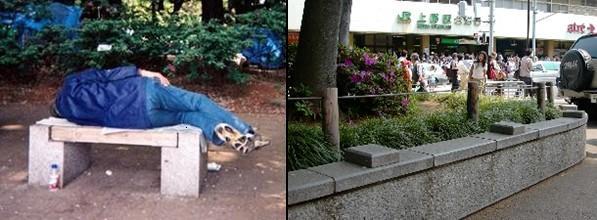
Anti-homeless architecture is growing and pushing back the poorest towards zones even more inhospitable. This ordered violence, indifferent to the sufferings of others, takes part in the degradation of human relations and is a quiet and paradoxical response to ultimate precariousness.

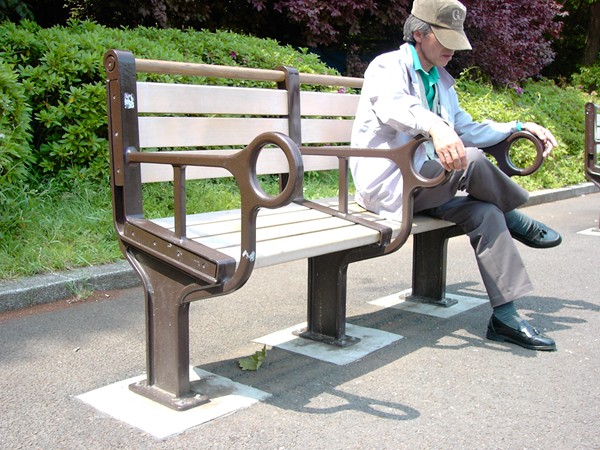
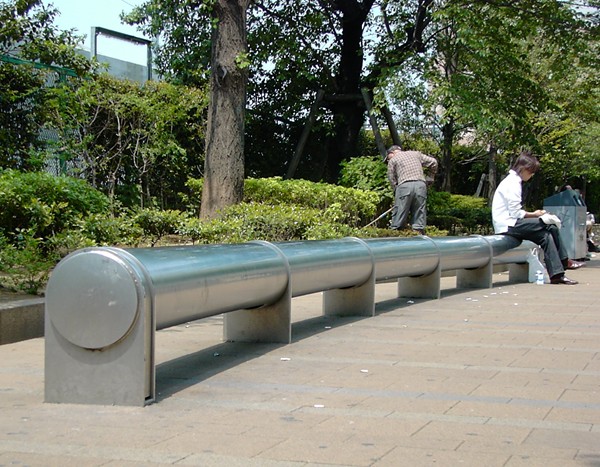
Anti-sitting, anti-homeless design. How inviting. 

This sort of thing isn’t only anti-homeless, it’s anti-life.
Everyone who sees this incurs mental harm. Each jagged edge is a whip that bullies us into forgetting that a city must retain a communal sense of ownership.
How is this success? Who wins when simply looking at the place you call home makes you flinch?
What is Discriminatory Design? It is design intended to manage people. Usually, it is intended to manage people who fall into categories that the powers-that-be find to be a nuisance, or worse. It could be spikes to prevent the homeless from sitting, sleeping, or lying down. 
It could be creating separate entrances to the same building, one for poor residents and one for the wealthy. It could be benches designed [ostensibly] for one person, or benches so uncomfortable that one can only sit for a few minutes before needing to get up. 
Some cities have gotten creative in their discriminatory design, making the designs into "Art Pieces."   As the article states, "One cannot sit on these colorful "artistic" objects, strategically placed to give the impression that one can rest, but having the opposite function."  The author asks, "Are public places for everyone?"


Clearly, no one in #CLMOOC is purposely using discriminatory design.

But I think it is important in any arena which is inherently entitled, such as an online class, to keep in mind those design elements which might be unintentionally preventing people from feeling included, safe, welcome or welcomed.  Like the frog in the pot of water on the stove who doesn't realize that the temperature is rising until it is too late, we can become so immersed in our own experience that we forget what it feels like from different perspectives.  

Are there spikes on any of our benches that we were not aware of?  

"Hospitality is not in the place it is in the human."

Yesterday I sent out a survey to briefly gauge how comfortable people are feeling with #CLMOOC.  Since there are over 2000 people in the Community, and so far 34 have responded to the survey, I can't say that it is a scientific representation, but I have found that anonymous surveys tend to attract a decent cross-section of those who are fairly content and those who have concerns that they haven't been able to express in another arena.  

What is one word you would use to describe #CLMOOC right now? 
White
Exciting!
Bubbling
Peculiar
Limited
Fun
confusing
energy
Energizing
intriguing
Catalyst
catalyst
play
busy
Creating
collaborative
Inspiring
positive
opportunity
energetic!
inspiring
opening
intriguing
Fun
frantic
Create
overwhelming
exploring
rejuvinating
Disorganised
tentative
What is one question you have for or about #CLMOOC?

Are all the prompts connected to connected learning principles?
????
Connected to each other by...what?
What's going on? What am I making?
When are you going to stop dictating and start involving all of us in designing this?
I am pretty sure I officially signed up, but I haven't received a newsletter email yet. Where should I check to make sure that I am actually registered?
I do not see a purpose for the "untro" and feel it is a wasted week. It is too deep, too complex. If you want new invitees to feel comfortable in this space, it had better start in an easy to understand manner. What is the purpose of the week 1 make? How would I bring this into my classroom and use with students, or into a staff meeting to use with staff? I just don't see it and I am a creative person. Honestly, this 1st week is a huge potential turn-off to newbies. I'm hoping next week is more practical.
How do we build community [based on tweet https://twitter.com/NomadWarMachine/status/613491511989174272 ]
How important is it that your experience in the mooc transfer to your classroom? Is the mooc about nuts and bolts or inspiration?
I don't know enough yet to have questions.
Any representation of clmoocers at ISTE2015?
How long does an individual cycle last? Is it only a week?
How do we find more equity? (e.g. How do we make this less for "insiders"?)
How will I apply this experience in my teaching?
None
Where are we going?
Do you really want 2000 people posting their make projects? I posted my intro first night, but now it is overwhelming with un-intros.
How long will the links last?
How can CLMOOC concepts be made more appealing (obviously relevant and beneficial) to a wider audience, and a broader number of disciplines?
Is there enough collaboration going on? or just silos?
How do I become more involved and what are examples of transferring CLMOOC experiences in the classroom?
How will we get every one to feel ownership of clmooc.
Any plans to make this a year-round thing?
Where are we heading?
Where have all these wonderful people been?
How can we get even more people involved?
Did anybody think about how this was going to work? It does not seem as if any of the 'organisers' have any expertise. For example, the first 'webinar' was a shambles of people chatting, not a webinar at all, and the first make is ridiculous. I thought this was a community mooc, it's not. The organisers are just up themselves.
Must it be visual?
[Thank you to everyone who has responded or will respond to the survey!]

I will let you do your own analyses of the responses so far.

In the meantime, I challenge us to create solutions to any barriers that might exist in our design, if any.

Creative Solutions
The following people have responded to design issues very creatively: 

Rain City Housing created benches that became shelters: raincity

Michael Rakowitz designed paraSITE shelters as practical solutions and a protest against policies that he felt were harmful to homeless people:

Sara Ross  designed outfits that would allow the wearer to circumvent the spikes or discomfort:
Archisuit in use on bench

Finally, this video shows how a community in Oxford worked to create a sense of place where people would WANT to be, rather than using speed bumps and negative architecture to try to control people. "A painted "street carpet" was used to slow down speeding traffic and create a greater sense of place...Rather than forcing drivers through physical features like speed humps, and making pedestrians feel they can't use the space, it makes them aware of their surroundings and the street as a place for people."

I am playing devil's advocate here. Are there ways that we can create more of a sense of place in #CLMOOC?  
Are there ways we can more creatively make this experience more equitable?  More welcoming to new players? 
Can communication be improved somehow?  Does it need to be improved? Does it need to be more equitable? 
Are there inherent design issues that we can improve? 

No experience can be or will be positive and productive for every player.  But since we are asked to create "a space where equity and diversity are hallmarks of a shared 'we'," I think we need to at least ask the questions.

What do you think?


Peace in the questioning,
Susan @eatcherveggies


Saturday, May 23, 2015

Women Who Wear Makeup Get Paid More:

The Beauty of an Even Playing Field


    As Ty Kiisel points out here, humans tend to judge and get judged, consciously, or unconsciously, by our appearances. He references this article by Aaron Gouveia, citing research that our appearances affect
many things at work, e.g. tall people get paid more, fat people [his words, not mine] get paid less, women who wear makeup get paid more, etc. Brian Tracy, a "personal success authority" says: 
"Your clothes are responsible for 95 percent of the first impression that you make on someone because, in most instances, your clothes cover 95 percent of your body. Your grooming, your hair style and the other ways you can determine your appearance from the neck up also exert an inordinate influence on the way that you are perceived, on your ethos with someone. "

[I realize these may be U.S.-centric examples, but I don't want to speak of things I don't know anything about. So please add your own cultural examples in the comments if you can.]

What is my point?


Connected Courses such as #rhizo15, #CLMOOC, #connectedcourses, etc. create a playing field more even than most f2f learning situations.  We interact with people primarily for the value of their work, their humor, their interactions, their willingness to share and be vulnerable, their willingness to connect reciprocally.  It has little, very little, to do with anything superficial, such as what they look like or wear.

I would like to think that happens in most real life learning environments, too.  But I am not that naive.

Fortunately for most of us, in connected courses, we can work and interact with each other in our pajamas, our farm duds, with babyfood smeared on our hijab, or muddy dog prints on our jeans, no make-up, hair uncombed.


If you met me in person, you would know that I have nine tattoos, short grey hair, and dress pretty androgynously.

This week Kevin made a cartoon version of me, which I loved.  He got the hair pretty close, but I never wear skirts/dresses, and let's just say sweaters don't look that good on me, and we'll leave it at that (LOL).

I have on many occasions been judged for my tattoos, my lack of feminine attire, etc.  But those things are not a factor in courses like Rhizo and CLMOOC. We find out about each other in dribs and drabs, already having had valuable interactions that are far more important than finding out someone has tattoos.

I don't know if you are heavy or skinny, masculine or feminine, sloppy or neat, disheveled or tall or short.  It points out how unimportant our actual appearances are to our interactions.

Many of us have, at different times, made cartoon versions of each other.    

However, I am always mindful of the potential for cultural ignorance (in myself), so I always ask the person directly, if I am in doubt.  We recently made a happy birthday video for Kevin, our cartoon master.  I made cartoon superhero versions of participants, and didn't want to do anything to Maha Bali's character that would be culturally offensive. This is what I ended up with, after consultation with her:

It is rather freeing, really, to be judged by the quality of one's work and the reciprocity of one's interactions. And not by the weight of any other scale.

As you find out more about what someone in an online course looks like, does it change how you think of them? Does it change how you interact with them?


[Maha and I have chatted about how other things aside from physical appearance affect our perceptions of each other, but she has written about that far more eloquently than I could.]

Now I am going to go put on pants.


Monday, March 30, 2015

Quicksand, Ellipses

trailing off,
my thoughts have been...

trailing off,
my posts have been...

trailing off,
my certainty has been...

Hesitation
has become both a strength
and a weakness.

Patience
has become both an asset and a
manipulation.

Thinking in ellipses 
is perhaps a product of age, or decline, or 
maybe an egress...

Where am I going?

To avoid clichés at any cost,
we put together words like 
neuronal emersion
or violet tenderness.

I connect
with people, pencils, comrades, airwaves, bluegrass, trees, crows, breezes.

Balance remains out of reach.
The swamp calls...
No, the swamp grabs. Pulls me under.

It smells of primordial ooze, diamonds, sweat, acorns, twisted steel.

It is quicksand.
Quick. Sand.
I float above myself and see my hand reach up from the mud.

In cartoons when I was a kid, they said if you fall in quicksand, don't panic.
Float. On your back.

No one talks any more about quicksand.

It used to be one of my fears.
Nuclear bombs and quicksand.

I roll onto my back
and float,
breathing in the scent of contrails.
And wait...


Monday, August 4, 2014

Deckadence


I sit decadently on my deck each night and eat the newest freshest peas right off the vine. To heck with acid rain, 
this is my version of organic. 
Nothing has ever tasted better. I made this food.
I chase it with a beer.

I grow things now.  I never used to.  I can't get past the addictive nature of creating something from a seed, food I can actually eat.  In my kitchen are jars of seeds, sprouts in pans, little tiny tendrils of nutrition.  I fend off the apocalypse for one more day.  Surely with these seeds, I can survive a while longer.  They are my mid-life babies, my menopausal offspring. They surround me with green when the world feels bloody gray and hopeless.

My deck is my sanctuary, my neighborhood not the best, the boards under my feet warped and worn, my grass not always trimmed the way the HOA would like, this is middle class, make no bones about it.  The cops who visit the courts don't see the irony of all of the "being in court" but they come here often anyway.  They are our entertainment through the windows as the crazy neighbor screams illogical nonsense at her boyfriend and child.  I am grateful for police diligence but allow myself to watch the craziness, that was me once, long ago, so I see both sides. 

I sit and listen, I feed my birds, I thrill in the bright yellow finches, the mischievous chickadees, the tiny chipping sparrows with itty bitty rooster combs that pop up at odd times.  
Right now it's fledgeling time; adolescent birds holler and beg their way through the day while patient parents feed them the seeds they could easily get for themselves. I like these mom and dad birds, the way they shield their children from the eventual reality for as long as possible.  


A robin has laid two clutches in my shed this summer, on top of a humane trap I used for catching baby stray cats. I love this irony as well, she chose the perfect spot, no predator can reach her chicklets.  She lets me see them, I anthropomorphize enough to think she trusts me. 

Here's my morning - feed the cats, make tea, grab a book, go check on the garden.  Examine each leaf while wearing reading glasses.  Add food to bird feeder. Sit on deck and read for as long as possible before life calls.

I have no hot tub, no expensive trips, but I can see the mountains from my deck, and things are growing.  Everywhere I look, I see green.  My neighbor cut my grass the other day.  My other neighbor offered me steamed crabs over the fence.  My neighbors are all colors, shapes and sizes. Make no bones about it, this is middle class.  Life is good. I choose this.